Volvo trucks
Volvo’s North American truck names distinguish long-haul, regional, vocational and auto-hauling roles. Generation is particularly important when reading VNL and VNR specifications: manufacturer pages may describe an all-new platform while used listings refer to an earlier design. The profiles below focus on each model family’s role and the questions needed to compare actual vehicles. European Volvo models and specifications are outside this directory’s scope.
Compare the model families
| Model / family | Application | Overview | Model notes |
|---|---|---|---|
| VNL | Long-haul highway truck | The VNL is Volvo’s North American long-haul family. The current manufacturer page describes a D13 engine and I-Shift automated manual powertrain, with several day-cab and sleeper configurations. Those current details should not be applied automatically to earlier VNL generations. | Read the profile → |
| VNR | Regional highway truck | The VNR is Volvo’s regional-truck family. Volvo’s current page includes day-cab, sleeper and truck configurations, and distinguishes the all-new VNR from earlier vehicles. Regional is an application description, not a guarantee that every configuration suits a particular delivery route. | Read the profile → |
| VHD | Vocational truck | Volvo positions the VHD for vocational work. The name identifies a work-focused family, separate from the VNL highway and VAH auto-hauling ranges. The particular body, axle arrangement and powertrain must still be established from the vehicle’s build information. | In this guide |
| VAH | Auto-hauling truck | The VAH is Volvo’s North American auto-hauler model. Volvo describes it as a low-profile platform for vehicle transport. This makes the carrier and loading arrangement central to the specification, rather than an accessory to an otherwise standard freight tractor. | In this guide |
| VNX | Vocational and heavy-haul truck | This reference covers the VNX generation unveiled in October 2026 for North American vocational and heavy-haul work. Volvo scheduled sales to begin October 26, 2026. That announced start date does not establish a delivery date for an individual truck. Earlier VNX vehicles need their own generation-specific documentation. | Read the profile → |
Bring the exact specification.
The family name helps organize your search. The build sheet, serial number and relevant manufacturer documentation identify what is installed. Compare like-for-like applications and request evidence for cost or performance claims.
Manufacturer references support the model facts. Our examples and comparisons are editorial interpretation prepared with AI assistance, not road tests or an expert inspection.
Check the year, market and exact build before applying a specification. This guide does not authorize parts fitment, repairs, modifications or loading.
Volvo manufacturer reference ↗Independent editorial resource. Brand names identify equipment; they do not imply a partnership or endorsement.
VHD
Vocational truck
Source checkpoint:
Volvo positions the VHD for vocational work. The name identifies a work-focused family, separate from the VNL highway and VAH auto-hauling ranges. The particular body, axle arrangement and powertrain must still be established from the vehicle’s build information.
Scope North American model family; equipment and availability vary by model year and configuration.
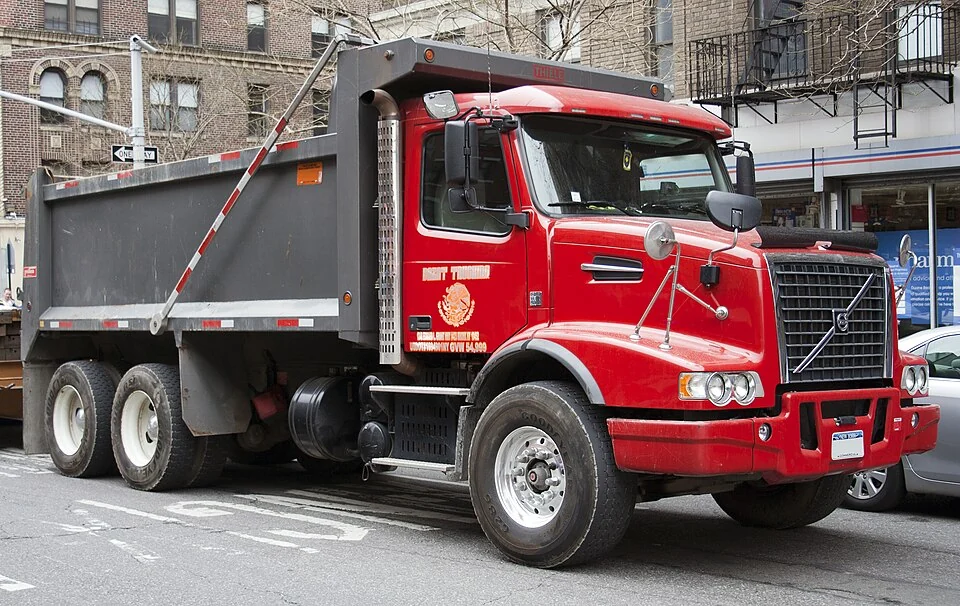
2010 Volvo VHD dump truck, photographed in 2012. Representative of the earlier VHD exterior generation.
2010 Volvo VHD dumper.jpgPhoto: Mr.choppers · Original photo ↗ · CC BY-SA 3.0Resized for display. The pictured configuration may differ from your vehicle.
Two cab types, two front-axle layouts
Volvo separates the VHD 300 day cab from the VHD 400 sleeper, and lists both axle-back and axle-forward versions of each. The catalogue associates axle-back with manoeuvrability and axle-forward with wheelbase and weight-distribution requirements. These labels describe chassis choices, not automatic proof of a turning radius or a permitted load. The full description, such as “VHD 300 axle back,” is therefore more useful than VHD alone when matching a body proposal.
Separate road access from body placement
For a roll-off or mixer comparison, mark the front axle and body position on both drawings and list the tightest access point separately. A cab photograph cannot resolve either issue by itself. The configuration that appears shorter at the front may still use a different wheelbase or body overhang. Comparing those dimensions independently helps explain why two VHD proposals differ, without assuming that either axle layout is universally better for every jobsite or loading pattern.
What matters in a comparison
With a VHD, start from what the body must do and how the loaded vehicle will be used. Ask for a weight distribution and application-specific chassis proposal. Service history should distinguish road distance from engine and body operating hours. For a used truck, verify whether its current body is the original installation and whether later changes have supporting documentation.
Questions to take to the supplier
- What body and axle configuration was approved?
- Are stationary operating hours documented?
- Do any body changes have installation records?
Sources & limits
VAH
Auto-hauling truck
Source checkpoint:
The VAH is Volvo’s North American auto-hauler model. Volvo describes it as a low-profile platform for vehicle transport. This makes the carrier and loading arrangement central to the specification, rather than an accessory to an otherwise standard freight tractor.
Scope North American model family; equipment and availability vary by model year and configuration.
The sleeper is part of the carrier package
Volvo identifies the VAH 300 as a day cab, the VAH 400 with a 42-inch flat-roof sleeper and the VAH 600 with a 61-inch flat-roof sleeper. Its auto-hauler description also names deep-drop front axles, low-height rear air suspension and reduced-height cab choices. The low roof is therefore one element of a coordinated vehicle layout; it is not a complete description of the clearance available above the finished carrier.
Compare a representative load arrangement
For a carrier handling a mix of cars and taller vehicles, ask for a representative loading drawing showing the over-cab position as well as the trailer. Compare that same load arrangement across the proposed cab choices. A change from day cab to sleeper changes the package being planned, even when both roofs look low in a photograph. Keep vehicle count separate from usable clearance and axle weights: a general brochure capacity does not establish the capacity of that mixed load.
What matters in a comparison
Compare a VAH with the actual vehicle carrier it will operate. Obtain the completed combination’s loading envelope and weight distribution for the types of vehicles to be carried. A low-profile model description does not establish loaded height or permissible axle weights. Include carrier-equipment maintenance, loading needs and access to specialist service when comparing total operating costs.
Questions to take to the supplier
- Which carrier and loading configuration is installed?
- What loaded height and weight calculations are available?
- Are truck and carrier service records both included?
Sources & limits
Updates about this equipment
All blog posts →Volvo’s new VNX: three checks before putting it on the shortlist
A job brief, complete truck-and-body quote comparison and delivery checklist for fleets considering Volvo’s new-generation VNX.
Read updateVolvo’s unattended updates: what to confirm before changing your maintenance routine
A practical pilot plan for Volvo’s unattended software updates: eligibility, dispatch handover, unresolved updates and a worked cost comparison.
Read update