Peterbilt trucks
Peterbilt model numbers cover different types of work, from highway tractors to medium-duty distribution and refuse collection. Compare the purpose of the chassis before comparing trim. The following profiles help distinguish the model families; the actual vehicle’s build sheet determines the engine, transmission, axle ratings and equipment. For body-equipped trucks, involve the body builder before deciding that a particular chassis is suitable.
Compare the model families
| Model / family | Application | Overview | Model notes |
|---|---|---|---|
| 579 | Aerodynamic highway truck | Peterbilt’s 579 is a highway-truck family, distinct from the traditional-style 589 and vocational 567. The useful comparison is the complete tractor specification and cab arrangement, rather than the badge alone. Cab equipment and drivetrain choices can materially change what a particular example offers. | Read the profile → |
| 589 | Traditional-style highway truck | The Peterbilt 589 is the brand’s traditional-style highway model. It is a separate model designation from the 579, and should also be distinguished from older 389 listings. A traditional appearance does not establish the specifications of the engine, transmission or axles underneath it. | In this guide |
| 567 | Vocational truck | Peterbilt lists the 567 as a Class 8 vocational truck. It is a chassis family for work-focused configurations, rather than one fixed body or payload. A 567 used as a tractor and a 567 carrying a specialized body need different specification discussions. | Read the profile → |
| 520 | Low-cab refuse truck | The 520 is Peterbilt’s low-cab vocational model associated with refuse collection. The manufacturer lists it in the Class 8 vocational range. Its collection-oriented layout makes it a different comparison from a conventional highway tractor or a general medium-duty delivery truck. | In this guide |
| 548 | Class 8 medium-duty-range truck | Peterbilt places the 548 in its medium-duty product range while identifying the chassis as Class 8. That illustrates why a marketing category should not replace the truck’s actual rating. Use the 548 designation to find the platform, then verify the configuration and completed vehicle. | In this guide |
| 537 | Class 7 work truck | Peterbilt identifies the 537 as a Class 7 member of its medium-duty range. It sits between lighter 535/536 configurations and the Class 8 548 in the manufacturer’s model structure. That family relationship helps narrow a search, but does not specify a completed truck’s payload. | In this guide |
| 536 | Class 6 work truck | The 536 is Peterbilt’s Class 6 medium-duty model, with the manufacturer listing a gross vehicle weight rating up to 26,000 lb. That is a vehicle rating, not a cargo allowance. The body and all permanent equipment must be accounted for before evaluating what it can carry. | In this guide |
| 535 | Class 5 work truck | The 535 is Peterbilt’s Class 5 entry in its medium-duty range. Peterbilt lists this model with a gross vehicle weight rating up to 19,500 lb. It should be compared as a complete work vehicle, because a substantial body or equipment package can use much of the chassis allowance. | In this guide |
| 220 | Cab-over medium-duty truck | Peterbilt’s 220 is a cab-over model in Classes 6 and 7. The manufacturer lists ratings from 26,000 to 33,000 lb. Its cab layout distinguishes it from the conventional-hood 535–548 range and is relevant when evaluating body packaging and delivery access. | In this guide |
Bring the exact specification.
The family name helps organize your search. The build sheet, serial number and relevant manufacturer documentation identify what is installed. Compare like-for-like applications and request evidence for cost or performance claims.
Manufacturer references support the model facts. Our examples and comparisons are editorial interpretation prepared with AI assistance, not road tests or an expert inspection.
Check the year, market and exact build before applying a specification. This guide does not authorize parts fitment, repairs, modifications or loading.
Peterbilt manufacturer reference ↗Independent editorial resource. Brand names identify equipment; they do not imply a partnership or endorsement.
589
Traditional-style highway truck
Source checkpoint:
The Peterbilt 589 is the brand’s traditional-style highway model. It is a separate model designation from the 579, and should also be distinguished from older 389 listings. A traditional appearance does not establish the specifications of the engine, transmission or axles underneath it.
Scope North American model family; equipment and availability vary by model year and configuration.
Distinguish the 589 platform from the 389
Peterbilt describes the 589 as moving from the 389’s 1.9-metre platform to a 2.1-metre platform. Its ordering announcement identifies 121- and 131-inch BBC hood configurations, with production beginning in January 2024. These distinctions are more useful than calling every traditional Peterbilt a “long hood.” Keep the exact model, hood configuration and cab platform together when identifying a used truck, particularly where familiar styling or accessories make different generations look alike in advertisement photographs.
Sort short- and long-hood quotations correctly
The two advertised BBC options differ by 10 inches, but that does not establish a 10-inch difference in the overall length of any two completed tractors. Sleeper, wheelbase and fifth-wheel position may differ too. For a useful price comparison, hold those other entries constant where possible and identify the hood option explicitly. Likewise, accessories carried over from a 389 need their own application check: shared appearance is not evidence of attachment-point or cab-dimension compatibility with the 589.
What matters in a comparison
Evaluate a 589 as both a work tool and an ownership commitment. Put the acquisition premium, operating assumptions and expected workload in separate lines of the budget. Check overall combination dimensions and access requirements at the places it must load. If comparing with a used 389, compare model year, condition and records explicitly rather than assuming the difference is cosmetic.
Questions to take to the supplier
- What equipment is included in the quoted price?
- How does the combination fit the actual loading sites?
- Which year-specific documentation supports the build?
Sources & limits
520
Low-cab refuse truck
Source checkpoint:
The 520 is Peterbilt’s low-cab vocational model associated with refuse collection. The manufacturer lists it in the Class 8 vocational range. Its collection-oriented layout makes it a different comparison from a conventional highway tractor or a general medium-duty delivery truck.
Scope North American model family; equipment and availability vary by model year and configuration.
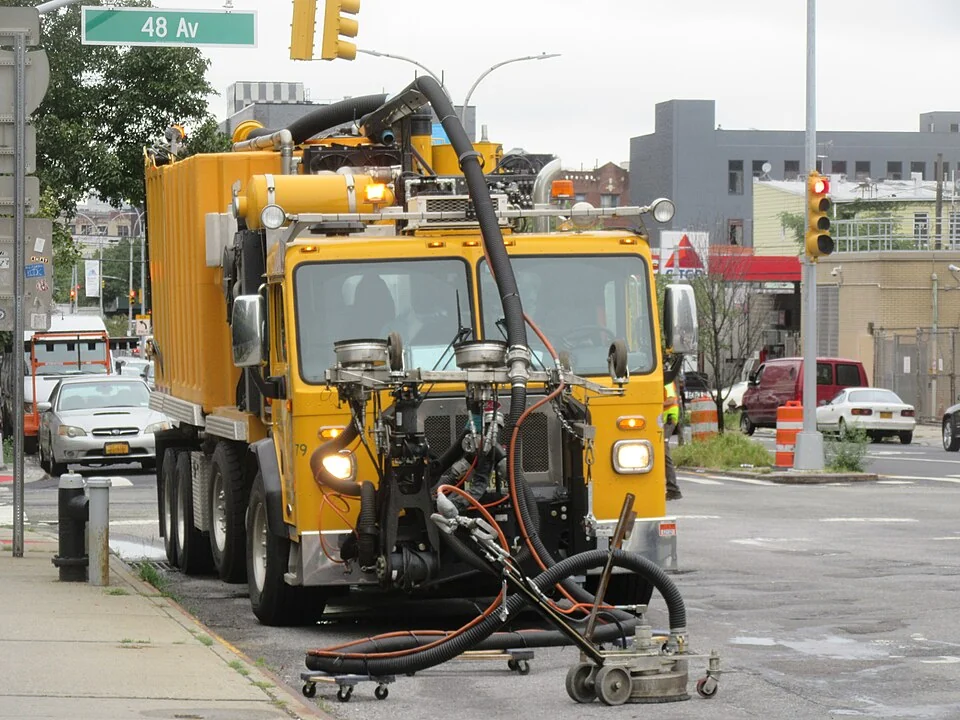
Peterbilt 520 with a specialized vacuum body in New York City, photographed in September 2018. Model year not established.
Peterbilt 520.jpgPhoto: Jason Lawrence from New York · Original photo ↗ · CC BY 2.0Resized for display. The pictured configuration may differ from your vehicle.
Match the driving station to the collection task
Peterbilt lists the 520 with left-hand, right-hand and dual-drive arrangements, including a right-hand stand-up configuration. These are materially different workplaces within the same model family. “Low cab refuse truck” does not identify which controls are available on which side. Begin a used-truck review with the actual cab layout and its operator’s manual, then identify the body and collection method. A photograph taken through one open door may omit the second station or its control arrangement.
Separate road travel from collection operation
In an illustrative route comparison, list the road-transfer stage and the curbside collection stage separately. For each, note the intended operating station, body-control location, visibility requirements and relevant operating limits from the correct manuals. This reveals whether two 520 quotations describe the same working arrangement. It is not permission to use a stand-up station for unrestricted road travel. Any demonstration or acceptance check should follow the vehicle and body manufacturers’ procedures, including station-change and interlock requirements.
What matters in a comparison
For collection work, build the specification around the body and collection method. Access to the driving position, visibility around the body and the number of stops belong in the evaluation. Budget using both distance and work intensity: route kilometres alone will not describe repeated stops or stationary body operation. Confirm the exact driving arrangement and body controls on the truck being considered.
Questions to take to the supplier
- Which refuse body and collection method is intended?
- Does the driving arrangement suit that route?
- Are body hours and maintenance records available?
Sources & limits
548
Class 8 medium-duty-range truck
Source checkpoint:
Peterbilt places the 548 in its medium-duty product range while identifying the chassis as Class 8. That illustrates why a marketing category should not replace the truck’s actual rating. Use the 548 designation to find the platform, then verify the configuration and completed vehicle.
Scope North American model family; equipment and availability vary by model year and configuration.
Identify the body interface on the newer 548
Peterbilt’s 548 sales sheet identifies VMUX multiplex electrical architecture for body integration. The model’s introduction also distinguishes an aero hood from a vocational hood with a stationary grille and full through rail. These choices affect how a specialised body is packaged and connected; the Class 8 badge alone does not identify them. When comparing chassis, record the hood configuration and electrical architecture as separate items instead of treating every 548 as the same ready-to-body platform.
A body-control specification needs more than switches
For an illustrative utility-body specification, list each operator command, the equipment it controls and the status information the operator needs back in the cab. Keep a request to run equipment separate from confirmation that it is running. Give the body installer the required interface and operating conditions, then retain the approved wiring and programming records with the truck. A row of labelled dashboard switches is not enough to establish that two used 548 trucks have interchangeable body-control systems.
What matters in a comparison
A 548 comparison should start with the work body and its loaded axle distribution. Check whether you need a heavier chassis for a real payload or equipment requirement, rather than selecting the largest number by default. Include the cost of body installation, auxiliary equipment and service support in the same monthly model. The empty chassis rating alone cannot tell you saleable payload.
Questions to take to the supplier
- What class and ratings are on this vehicle’s certification label?
- Which body loads determine the axle specification?
- How much cargo capacity remains after installation?
Sources & limits
537
Class 7 work truck
Source checkpoint:
Peterbilt identifies the 537 as a Class 7 member of its medium-duty range. It sits between lighter 535/536 configurations and the Class 8 548 in the manufacturer’s model structure. That family relationship helps narrow a search, but does not specify a completed truck’s payload.
Scope North American model family; equipment and availability vary by model year and configuration.
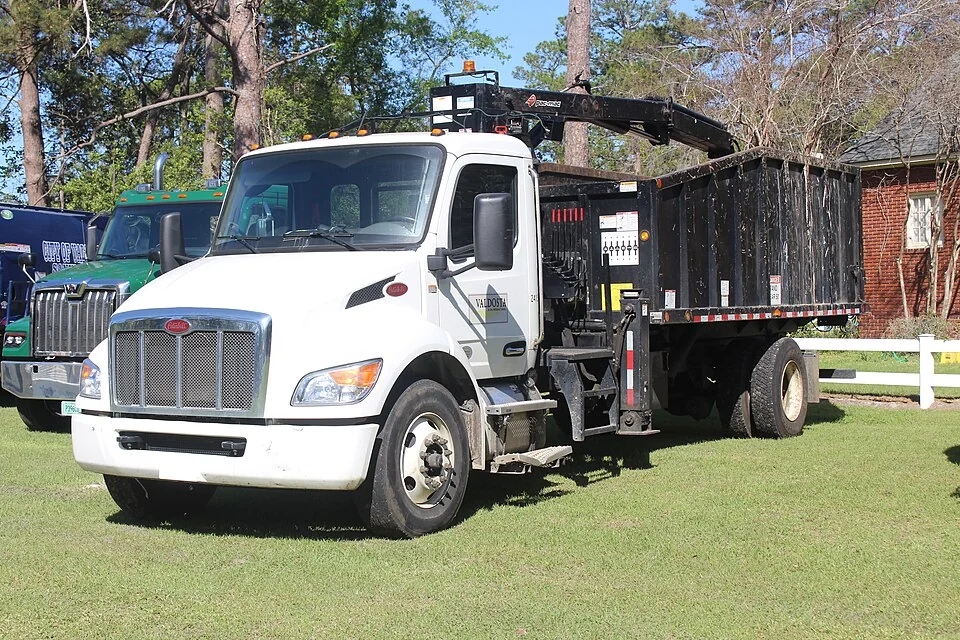
Peterbilt 537 grapple truck in Valdosta, Georgia, photographed in March 2026. Representative of the wide-cab medium-duty family; model year not established.
Azalea Festival 2026 18.jpgPhoto: Mjrmtg · Original photo ↗ · CC BY 4.0Resized for display. The pictured configuration may differ from your vehicle.
A 109-inch hood does not automatically mean FEPTO
Peterbilt lists 107- and 109-inch BBC aero hoods for the 537, plus a 109-inch FEPTO configuration with a stationary grille and through rails. FEPTO means front-engine power take-off. The shared 109-inch dimension therefore does not prove that a truck has the vocational front structure or a usable power take-off installation. Identify hood type, grille arrangement and the actual PTO equipment separately. This distinction matters when reviewing a service truck intended to power equipment at its front.
Compare a pump installation by the power path
Suppose a proposed 537 body requires a front-driven pump. On its installation drawing, trace the intended power path from engine to pump, then mark the frame structure, mounting locations and service access. Compare that drawing with the actual chassis specification. A front extension can provide physical space without establishing an approved drive arrangement or pump rating. Likewise, a PTO label does not tell you whether the fitted equipment matches the body’s required speed, direction and duty cycle.
What matters in a comparison
For a 537, compare body length, cargo density and the route’s access constraints. A box body that can hold the load by volume may still leave too little weight allowance for it. Ask for actual or calculated completed weight, including liftgate and permanent tools. For used vehicles, ensure the body configuration in the advert agrees with the records and certification information.
Questions to take to the supplier
- What is the usable payload with this body fitted?
- Are liftgate and permanent equipment weights counted?
- Does the wheelbase suit both the body and delivery sites?
536
Class 6 work truck
Source checkpoint:
The 536 is Peterbilt’s Class 6 medium-duty model, with the manufacturer listing a gross vehicle weight rating up to 26,000 lb. That is a vehicle rating, not a cargo allowance. The body and all permanent equipment must be accounted for before evaluating what it can carry.
Scope North American model family; equipment and availability vary by model year and configuration.
Identify which PX engine the 536 has
Peterbilt’s 536 specifications list both the 6.7 L PACCAR PX-7 and 8.9 L PACCAR PX-9 diesel engines. The number in the engine family name is not the exact displacement, and “536 diesel” does not distinguish the two. Record the engine model, serial identification and emissions generation before matching service information. For a used delivery truck, combine those identifiers with the actual maintenance record; the shared chassis model does not make all engine-related parts or schedules interchangeable.
Use measured consumption in a route calculation
Engine displacement cannot be entered as fuel consumption. In an illustrative route calculation, 500 km at 27 L/100 km requires 135 L of fuel, regardless of which model name heads the worksheet. The 27 L/100 km figure here is an example, not a prediction for either 536 engine. Compare actual route records with similar loads, stops and idling, then price that fuel. This prevents a bigger displacement or a higher advertised horsepower rating from being treated as a complete operating-cost result.
What matters in a comparison
A 536 can enter a shortlist when the operation needs a smaller commercial chassis, but the completed build must be the basis of comparison. Confirm cargo weight, body size and liftgate use before deciding it fits. Do not infer driver-licence requirements from a class label in a US-oriented brochure; check the actual jurisdiction and vehicle configuration separately.
Questions to take to the supplier
- What is the rated and completed empty weight?
- What cargo density is assumed?
- Does the route require equipment absent from the listing?
535
Class 5 work truck
Source checkpoint:
The 535 is Peterbilt’s Class 5 entry in its medium-duty range. Peterbilt lists this model with a gross vehicle weight rating up to 19,500 lb. It should be compared as a complete work vehicle, because a substantial body or equipment package can use much of the chassis allowance.
Scope North American model family; equipment and availability vary by model year and configuration.
Roof choice is separate from the weight class
Peterbilt lists the 535 at up to 19,500 lb GVWR and offers a flat roof or curved roof with 4 inches of additional headroom. A 535 badge therefore does not identify the cab’s vertical packaging. For a delivery truck entering a low building, distinguish cab roof, body roof and any rooftop equipment. Use the highest point of the completed vehicle for clearance planning; the cab-roof option alone does not establish its height above the ground.
A completed-weight example for a delivery 535
Illustrative example: a 19,500 lb-rated truck weighs 12,500 lb with its body, crew, fuel and fixed equipment, leaving 7,000 lb below GVWR. Adding 400 lb of permanent equipment reduces that arithmetic margin to 6,600 lb. These are invented example weights, not a Peterbilt payload specification. The usable load may be lower because of axle, tyre, body or operating limits. This is why comparing two 535 trucks by cargo-box volume alone can miss a meaningful difference in what they can carry.
What matters in a comparison
For a 535 service or delivery proposal, list tools, spare stock, passengers and the work body before estimating remaining payload. Compare the same fully equipped job with a 536 rather than comparing empty chassis prices. Access and parking can also shape the choice. Confirm any local licensing and operating requirements for the exact vehicle instead of relying on the model number.
Questions to take to the supplier
- What permanent equipment will always be carried?
- Is payload calculated with a full operating load?
- Would the next chassis size solve a documented constraint?
220
Cab-over medium-duty truck
Source checkpoint:
Peterbilt’s 220 is a cab-over model in Classes 6 and 7. The manufacturer lists ratings from 26,000 to 33,000 lb. Its cab layout distinguishes it from the conventional-hood 535–548 range and is relevant when evaluating body packaging and delivery access.
Scope North American model family; equipment and availability vary by model year and configuration.

Peterbilt 220 postal-delivery box truck in New York City, photographed in July 2021. Model year not established.
USPS Peterbilt 220 (51398993956).jpgPhoto: Jason Lawrence from New York · Original photo ↗ · CC BY 2.0Resized for display. The pictured configuration may differ from your vehicle..jpg)
Separate the diesel 220 from the 220EV
Peterbilt’s diesel 220 page identifies a PACCAR PX-7 engine and Allison automatic transmission. The separately documented 220EV uses a battery-electric drivetrain. Similar model numbers and a cab-over appearance therefore do not establish the same vehicle architecture. Before comparing a used cab-over quotation, record the full model designation and propulsion type. Then use the matching manuals and service information; do not combine diesel fuel-tank details with battery capacities from the electric model’s sales sheet.
Right-hand drive changes the delivery-work comparison
The diesel 220 page also lists a right-hand-drive configuration for specialised applications. For a delivery or service route, draw the intended stopping position, loading side and driver’s exit side before comparing it with a left-hand-drive truck. Body doors and equipment access can change the work sequence even when the cargo volume is identical. Evaluate the actual route and operating rules rather than assuming one steering position is universally better. Neither steering position nor the cab-over shape alone proves a particular turning clearance.
What matters in a comparison
A 220 comparison should examine the entire cab-and-body arrangement on the route. Ask about access to the engine for servicing, the body installation and how the driver enters and exits through a typical shift. Compare completed dimensions and payload with a conventional truck on the same job. The shorter-looking front layout is not a substitute for checking turning space with the actual wheelbase.
Questions to take to the supplier
- Which class and wheelbase are specified?
- How is service access preserved with the body installed?
- Does the completed vehicle fit loading and parking space?